As part of ECSD’s Budget & Funding Overview, this section explains how fiscal oversight works under Nevada’s Pupil-Centered Funding Plan (PCFP). Budget development and monitoring are shared responsibilities between the Elko County School District Board of Trustees, the Nevada Department of Education, and state oversight agencies. This system is designed to ensure transparency, accountability, and responsible stewardship of public funds.
ECSD’s Budget Cycle
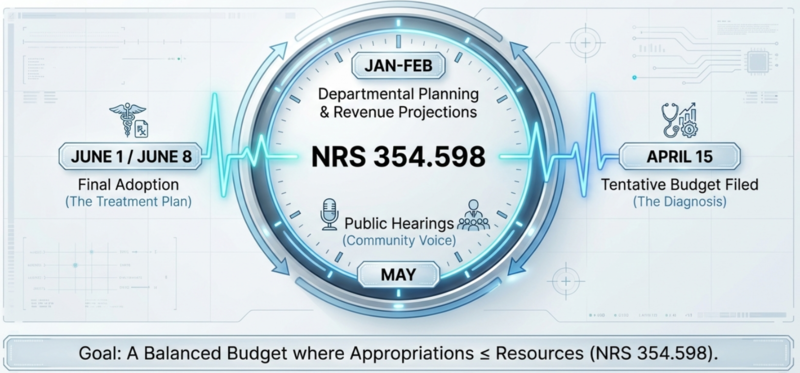
Each year, Elko County School District follows a structured budget cycle that includes:
Enrollment and revenue projections
Budget development and public review
Board consideration and approval
Ongoing monitoring and reporting throughout the school year
Role of the ECSD Board of Trustees
The Board of Trustees serves as the district’s governing body and holds the legal authority and fiduciary responsibility for the district’s budget. Board members are responsible for:
Reviewing and approving the annual district budget
Ensuring spending aligns with state law, district priorities, and student needs
Fiduciary Oversight and Policy
Providing public transparency through open meetings and discussion
The Board works closely with the Superintendent and district leadership to ask questions, review trends, and make informed decisions that reflect both fiscal responsibility and educational priorities.
Role of the Nevada Department of Taxation
The Nevada Department of Taxation (DoT) serves as the primary regulatory body ensuring the fiscal integrity and statutory compliance of school district budgets. While the Department of Education manages the distribution of per-pupil funding, the DoT oversees the technical and legal framework of a district’s financial operations.
Core Regulatory Functions
Statutory Budget Oversight: The DoT reviews tentative and final budgets to ensure compliance with the Local Government Budget Act. This includes verifying that districts utilize standardized reporting forms and adhere to legal spending limits.
Revenue Certification: The Department provides official projections for local tax revenues, including the Local School Support Tax (LSST). It is also responsible for the valuation of centrally assessed properties (utilities and mines) and the application of property tax abatements.
Audit and Compliance Monitoring: Districts are required to submit annual independent audits to the DoT. The Department monitors these reports for signs of structural deficits or non-compliance with Nevada Revised Statutes (NRS).
Fiscal Intervention: Through the Committee on Local Government Finance (CLGF), the DoT has the authority to place districts on "Fiscal Watch" or "Fiscal Emergency" status if they exhibit severe financial instability, providing a mechanism for state-level intervention to prevent insolvency.
Administrative Adjustments: The DoT processes mid-year budget augmentations and amended final budgets, ensuring that any changes in spending authority are documented and legally authorized.
Oversight by the Nevada Department of Education
The Nevada Department of Education (NDE) provides statewide oversight and guidance to ensure consistent application of the PCFP across all school districts.
NDE responsibilities include:
Maintaining the PCFP funding model, including enrollment projections, revenue calculations, and payment schedules
Establishing internal controls and business rules that guide how districts manage and report finances
Monitoring compliance with state funding laws and student-centered requirements
Reviewing financial submissions and audits, and supporting corrective action when needed
Nevada Revised Statutes (NRS Chapter 387) and related administrative codes establish the legal framework for this oversight.
How State Funding Is Determined
The state budget process begins with the Legislature establishing a statewide base per-pupil funding amount, which represents the estimated cost to educate one student.
From there:
District funding is adjusted to account for factors such as geographic considerations and operational costs
Funding is allocated for general education, transportation, and special education services
Additional weighted funding is added for students who require greater support, including English Language Learners, students from low-income households, students with disabilities, and gifted students
These weights are calculated as a multiplier of the base funding amount and are intended to assist districts in providing additional appropriate services for diverse student needs.
While lawmakers aim for funding to keep pace with inflation, total funding levels depend on the availability of resources in the state education budget.
Additional State Oversight
In limited and extraordinary circumstances, NRS 387.12455 allows the Governor to adjust funding through the legislative process. State law also includes provisions intended to ensure districts do not receive less funding than established baseline levels.
Collaboration and Fiscal Responsibility
Oversight is not only about compliance—it is also about coordination and shared responsibility.
The ECSD Board of Trustees, Superintendent, Nevada Department of Education, Department of Taxation, and Department of Treasury work together to:
Review financial conditions and trends
Discuss and implement corrective actions when needed
Ensure balanced budgets and long-term financial stability
Provide clear and timely information to the school community
Through this collaborative process, ECSD remains focused on responsible financial management while continuing to prioritize high-quality education for every student.